CFO and COO business case: continuous GRC readiness with Pulsar GRC and Crewshift
How to quantify the cost of audit firefighting and build a predictable operating model: Pulsar GRC structures requirements, risks, CAPA, and evidence, while Crewshift handles training, acknowledgements, and exercises.
Why this belongs on the CFO and COO agenda
Compliance is often treated as a cost owned by quality or compliance teams. In practice, the real cost spreads across operations, procurement, sales, finance, and senior management.
The CFO sees it in expert hours, delayed corrective actions, repeated advisory work, and commercial risk. The COO sees it in pre-audit crisis mode, cross-functional escalations, and uncertainty about whether evidence is complete.
The audit itself is rarely the biggest cost. The expensive part is the operating model where an organization has to reconstruct its compliance position every few months.
Where audit firefighting actually costs money
In a reactive model, teams usually do four things at once:
- collect documents and evidence from multiple places,
- reconstruct the link between a requirement, control, risk, and action,
- check whether CAPA has an owner, deadline, and effectiveness evidence,
- remind people about training, acknowledgements, and process changes.
This is not just administration. It is lost expert focus, delayed decisions, and commercial risk when a customer or auditor receives an incomplete picture of how the organization operates.
What the Brillnet-Pulsar-Crewshift model changes
The value of Brillnet-Pulsar-Crewshift comes from separating the work into two cooperating applications built on the same Brillnet compliance logic.
- Pulsar GRC structures the compliance layer: source documents, requirements, controls, risks, audits, CAPA, evidence, the Coverage Graph, and Gap Analysis.
- Crewshift structures the people and change-adoption layer: training, acknowledgements, competencies, role assignments, and scenario exercises.
- The Brillnet compliance engine supports both areas with process logic and controlled AI Act-aligned AI support. AI helps analyze and organize data, but decisions on acceptance, priority, and closure always stay with your Team and your Organization.
The business outcome is straightforward: the organization does not assemble an audit pack at the last moment. It builds a live compliance picture as part of daily work.
From a single audit to continuous operational readiness
Pulsar GRC works on your Organization’s documents stored in your isolated Data Area. Your Organization must have the source documents and requirements it wants to comply with. The platform does not sell standards content, normative texts, or ready-made requirement catalogues.
On your Organization’s data, Pulsar GRC helps create the workflow:
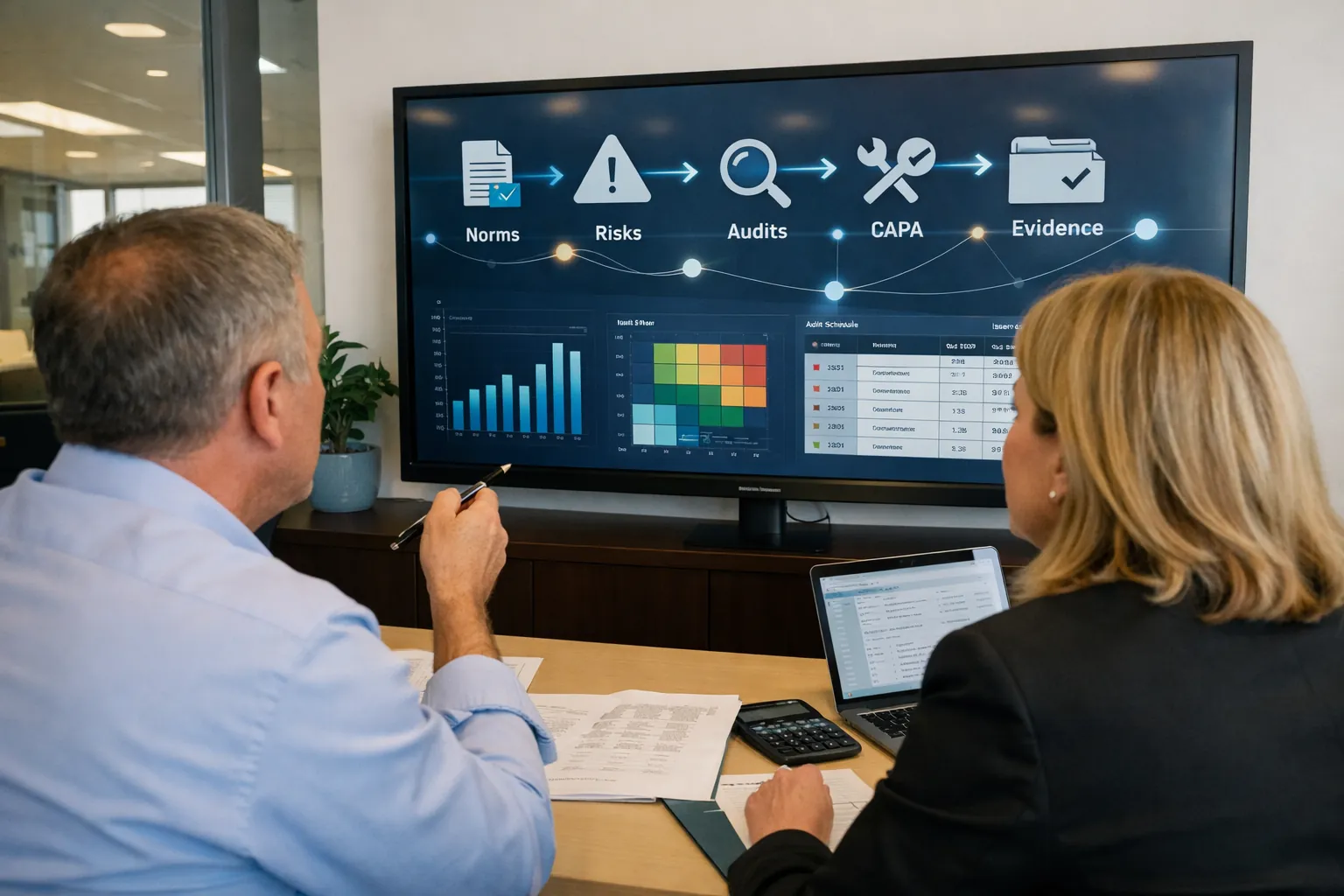
Source documents -> Requirements -> Controls -> Risks -> Audits -> CAPA -> Evidence
In this workflow, a requirement is no longer only a paragraph in a document. It becomes a work object linked to a control, owner, evidence, risk, and decision history. That produces the Coverage Graph and Gap Analysis.
If a gap requires action with people, Pulsar GRC does not pretend to be a training system. Crewshift handles that area: program, role assignment, completion acknowledgement, knowledge check, or scenario exercise.
Five value levers for CFO and COO
1) Less expert time spent reconstructing status
Experts should not spend time searching for the current document version, evidence item, or status. Pulsar GRC shortens the path from “are we ready?” to an answer based on connected objects: requirement, control, evidence, risk, and CAPA.
2) Faster CAPA closure
CAPA without owner, deadline, and effectiveness evidence quickly becomes a list of intentions. Pulsar GRC shows what is open, why it is open, who owns closure, and what evidence is required.
3) Better sequencing of decisions
CFOs and COOs need to know where action actually reduces operational or commercial risk. Connecting requirements, risks, audits, and CAPA helps shift attention from “what is loud” to “what has the highest impact.”
4) Evidence that change reached the team
In many audits, the problem is not the procedure itself, but uncertainty about whether the team understands the change and can perform it. Crewshift helps turn Pulsar GRC findings into training, acknowledgements, competency records, and exercises.
5) Knowledge stays in the Organization
Each audit, gap, decision, and evidence item becomes a better starting point for the next cycle. The Organization stops paying to rediscover the same relationships. Knowledge accumulates in the isolated Data Area and increases the value of later AI-supported analysis.
Three executive decision scenarios
Scenario 1: Audit readiness without an operational spike
- Situation: before an audit, the team manually collects evidence, statuses, and acknowledgements.
- COO decision: move readiness into a continuous requirement -> control -> evidence -> CAPA workflow.
- Outcome: fewer escalations, less ad hoc work, and more predictable readiness.
Scenario 2: CAPA cost becomes visible to finance
- Situation: corrective actions are open, but their risk impact and delay cost are unclear.
- CFO + COO decision: manage CAPA as a portfolio of actions with owners, priorities, deadlines, and effectiveness evidence.
- Outcome: budget and team capacity go where gap closure creates the highest business value.
Scenario 3: Process change requires people-side execution
- Situation: Gap Analysis shows that updating a procedure is not enough.
- COO + Quality/Compliance Manager decision: move training and acknowledgements into Crewshift.
- Outcome: the Organization can show not only a document, but evidence that the change reached the team.
A 30-minute ROI worksheet
Start with four practical numbers:
- Audit firefighting effort people × hours per cycle × loaded hourly cost.
- Delayed CAPA cost delayed actions × average delay or risk cost.
- Escalation cost escalations × management time × decision-time cost.
- Low-value work cost share of actions without clear impact × corrective-action budget.
Then compare the current state with a model where:
- requirements are mapped to controls and evidence,
- risks are visible in the context of actions,
- CAPA has an owner, deadline, and effectiveness evidence,
- training and acknowledgements resulting from gaps are handled in Crewshift,
- evidence packs are built during normal work, not in the final week before an audit.
This does not require assuming full automation. Even reducing reactive work and improving prioritization can create an effect CFOs and COOs can measure in time, cost, and fewer escalations.
Questions to ask before deciding
- How many hours did the last audit cycle spend only on finding evidence?
- How many CAPA actions stayed open longer than the process expected?
- How often did senior management have to resolve status because data lived in multiple places?
- How many gaps required not only a document, but also training, acknowledgement, or an exercise?
- Does the next audit start from knowledge gained in the previous cycle, or from another spreadsheet?
If these answers are hard to obtain, that is already part of the business case. The issue is not lack of work. The issue is lack of one operating view of compliance.
Want to translate this business case into your Organization’s process? Contact Brillnet and describe the audit, standard, or compliance area you want to structure.