
Risk management
5x5 inherent/residual risk matrix with risk appetite threshold. Risk-control-evidence coverage dashboard from the compliance graph.
GRC platform for teams that need control over risk
Pulsar GRC organizes risks, controls, audits, evidence, tasks, and reporting in one system with visible owners and decision history.
Requirements
ISO, BRCGS, IFS, NIS2
Evidence
audit-ready packs
Risks
owners and status
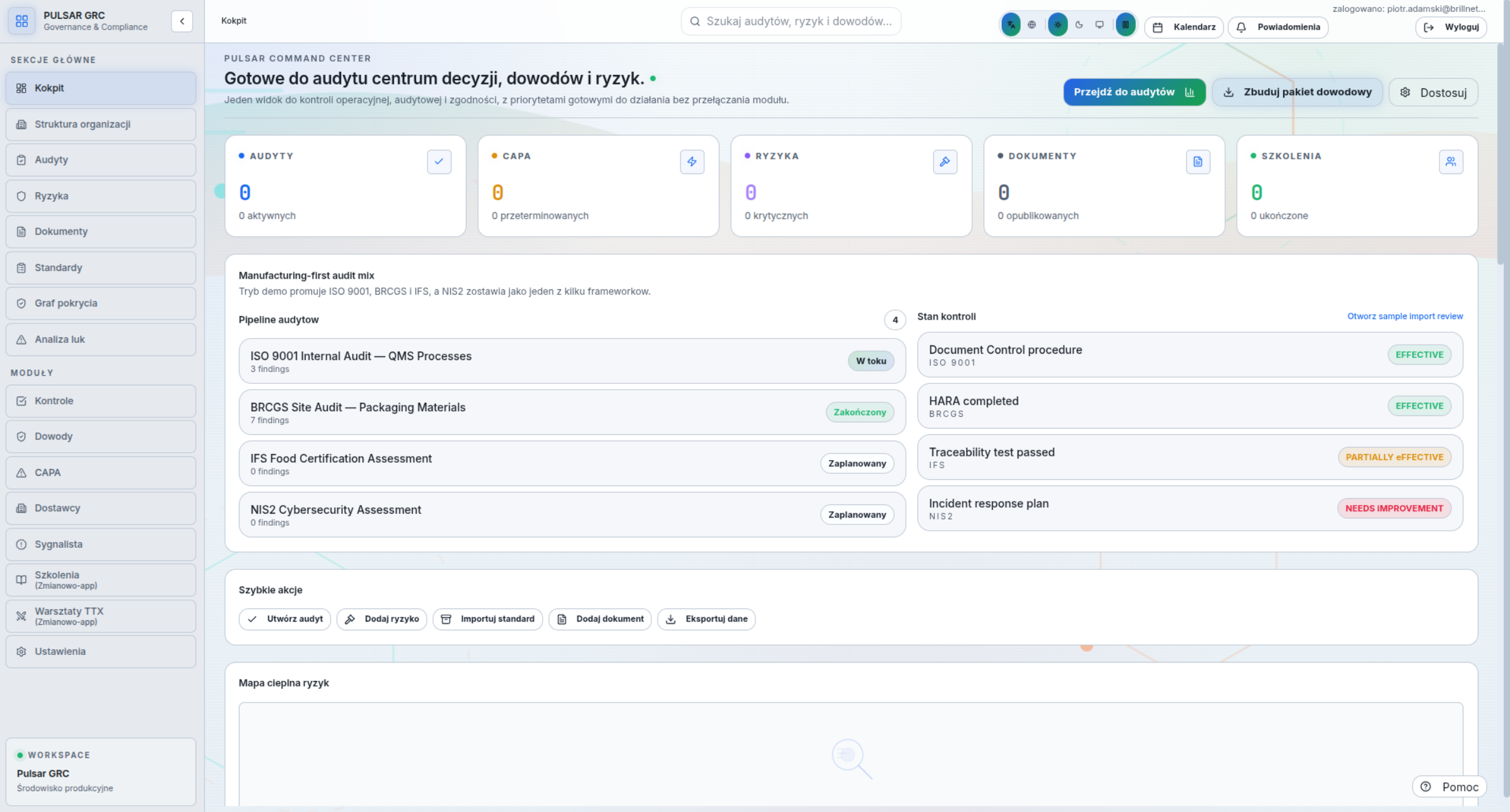
One source of truth for risks, controls, and evidence
Decision and audit trail for team actions
Reporting ready for leadership and audit reviews
Operational support for NIS2, DORA, ISO, and GDPR work
Platform
Pulsar GRC modules connect requirements, owners, controls, audits, and reporting into one operational workflow.
5x5 inherent/residual risk matrix with risk appetite threshold. Risk-control-evidence coverage dashboard from the compliance graph.
The requirement → control → evidence map supports ISO, BRCGS, IFS, GDPR, NIS2/KSC, and DORA work without scattered spreadsheets.
Planning with calendar and scope, automated checklists from mappings, findings register with evidence. PDF reports with evidence package.
Kanban CAPA with deadlines and escalation. Closure requires effectiveness verification plus evidence. Linked to risks and controls.
Repository with versioning, workflow draft to review to approved to obsolete. Read acknowledgments with escalation.
Clear views, coverage status, and evidence packs prepare teams for leadership, auditor, and process-owner conversations.
Process
Pulsar GRC guides teams through a concrete operating cycle: requirements, risks, controls, evidence, status, and reporting.
You capture requirements from standards, procedures, and regulations, then connect them with process risks.
Every control has an owner, responsibility scope, deadline, and a link back to the requirement.
Evidence, comments, and approvals stay in object history instead of getting buried in email threads.
Teams see gaps, overdue actions, CAPA, and risks that need decisions before the audit starts.
You produce a clear readiness picture for leadership, auditors, and process owners.
Controlled API/MCP layer
Approved AI Agents can use documented context for requirements, risks, audits, CAPA, and evidence. They help prepare analysis or the next step, while staying inside the same role, permission, and auditability boundaries as the rest of the workflow.

Security and auditability
Pulsar GRC supports compliance work: it shows responsibilities, keeps change history, and organizes evidence. Decisions, assessments, and approvals remain with your organization.
Roles and permissions help restrict access to the right work areas.
Changes, decisions, and approvals are visible as an auditable process trail.
Evidence is linked with requirements, controls, owners, and deadlines.
Reports and evidence packs help prepare reviews for auditors and leadership.
Product maintenance
The product should support everyday work, not only the launch day. During implementation we agree responsibilities, support channels, and change-handling rules.
The customer receives an agreed contact channel for operational requests, questions, and product-development discussions.
Hosting model, backup approach, and service recovery are confirmed for the specific implementation and recorded in the cooperation documents.
Before launch, we discuss access, roles, data classes, exports, incident handling, and the documents available on request.
Product changes are planned to support the customer's real processes. Priorities are discussed during implementation and later cooperation.
The customer remains responsible for process decisions, data owners, and how the tool is used inside the organization. Brillnet can provide additional remote implementation support.
Pulsar GRC
Let us review the process that still requires too much manual work: requirements, controls, evidence, CAPA, audits, and reporting.
Contact: kontakt@pulsar-grc.pl