Introduction to GRC: from requirements to operational readiness with Pulsar GRC and Crewshift
GRC is more than the definition of governance, risk, and compliance. It is a working model that connects requirements, risks, controls, CAPA, evidence, and team readiness. See how Pulsar GRC and Crewshift structure that flow.
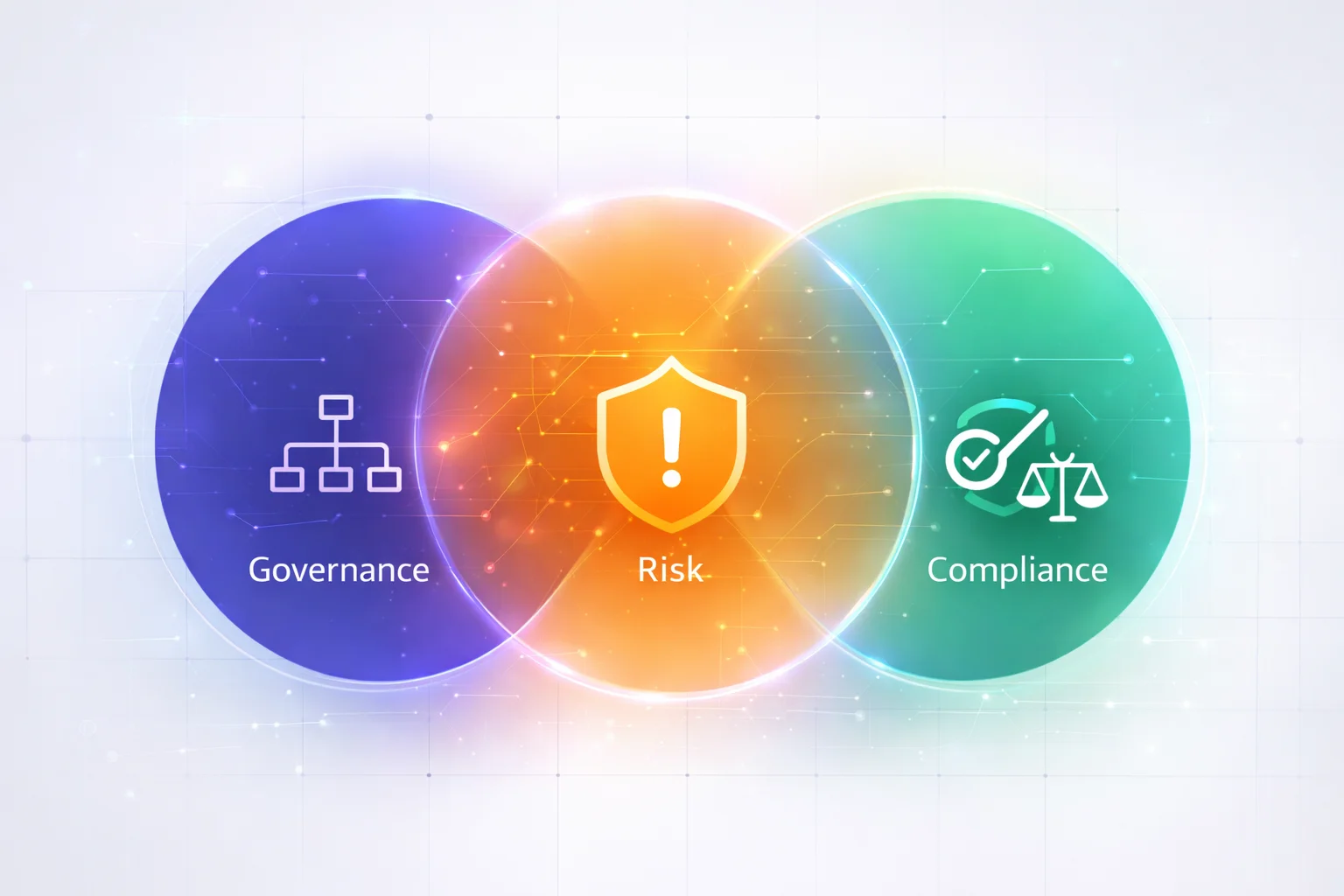
GRC starts with responsibility, not with software
GRC, or Governance, Risk & Compliance, brings together three areas that should work as one:
- Governance - who makes decisions, who owns the process, and how the Organization operates.
- Risk - which events could affect goals, quality, compliance, or operational continuity.
- Compliance - how the Organization proves alignment with laws, standards, procedures, customer requirements, and internal policies.
In many companies these areas exist, but they are fragmented. Documents sit in one place, risks in spreadsheets, CAPA in email threads, evidence in folders, and training records in a separate system or files. GRC then becomes last-minute audit preparation instead of a steady operating rhythm.
The value of the Brillnet platform is to structure that flow. Pulsar GRC organizes requirements, controls, risks, audits, CAPA, and evidence. Crewshift handles the people-side work: training, acknowledgements, competencies, and scenario exercises. Both applications use the same Brillnet compliance engine, but they solve different problems.
What does GRC mean in daily work?
For a Quality/Compliance Manager, GRC is not an abstract model. It is a way to answer practical questions:
- which requirements apply to our Organization,
- which source documents are current,
- which controls prove that requirements are met,
- where we have a gap and who owns its closure,
- whether CAPA has an owner, deadline, evidence, and proof that the action worked,
- whether the team understands what changed in a procedure,
- whether a consistent evidence package can be shown before an audit.
Pulsar GRC turns these questions into connected objects: document, requirement, control, evidence, risk, CAPA, owner, and decision. As a result, compliance status is not a statement from the last meeting. It is the outcome of work on your Organization’s data.
What makes the Brillnet-Pulsar-Crewshift model different?
Pulsar GRC works on your Organization’s documents stored in your isolated Data Area. Your Organization must have the source documents it wants to comply with: standards, procedures, legal requirements, customer requirements, or internal policies.
Brillnet does not sell standards content, normative texts, or ready-made requirement catalogues. The platform helps organize and map documents supplied by the Organization. On that basis, Pulsar GRC supports the creation of the Coverage Graph and Gap Analysis.
In practice, the flow is straightforward:
- The Quality/Compliance Manager imports source documents into the isolated Data Area.
- Pulsar GRC helps map requirements to controls, evidence, owners, and risks.
- The Coverage Graph shows what is already supported by evidence and what still needs work.
- Gap Analysis identifies missing elements, priorities, and dependencies.
- CAPA takes the team from a detected gap to closure.
- Crewshift handles actions that require work with people: training, acknowledgements, competencies, and scenario exercises.
AI acts as controlled process support. It helps organize, connect, and analyze data, but it does not replace the Organization’s decisions. Acceptance, priority, and closure decisions always remain with your Team and your Organization.
Example: manufacturing, quality, and audits
In manufacturing, GRC often meets ISO 9001, BRCGS, IFS Food, IATF 16949, customer-specific requirements, and local procedures. The issue is rarely that the Organization has no documents. The real issue is whether documents, controls, risks, and evidence form one coherent picture.
Pulsar GRC helps structure that layer:
- a requirement from a standard or customer requirement connects to a specific control,
- the control has evidence, an owner, and decision history,
- a gap moves into Gap Analysis and then into CAPA,
- risk shows operational impact and priority,
- an evidence package can be prepared without manually searching several places.
When an analysis result requires action with people, Crewshift carries the next stage. That may be training on a new procedure, acknowledgement of an instruction, a competency record, or a scenario exercise before an audit. Compliance then does not stop at the document. It reaches the team that needs to understand and perform the change.
What problems does mature GRC solve?
GRC creates the most value when the Organization stops working reactively. Instead of assembling evidence during the final week before an audit, the team sees readiness continuously.
Mature GRC helps reduce:
- repeated questions across different audits,
- manual evidence collection from email and folders,
- unclear CAPA ownership,
- requirements that are “met” only in a spreadsheet,
- missing links between a gap, risk, evidence, and training,
- knowledge loss when the process owner changes.
In the Brillnet architecture, Organizational knowledge can grow inside the isolated Data Area and support AI through RAG. Over time, the system better reflects the Organization’s way of working, decision history, common gaps, evidence, and dependencies. This is a practical form of continuous improvement: the Organization does not start from zero before every audit or every change in requirements.
How to start without adding chaos
You do not need to start with a full transformation program. It is better to choose one process where fragmented information already creates real cost for the team:
- Choose a compliance area - a customer audit, BRCGS, ISO 9001, CAPA, risk register, or supplier process.
- Collect source documents - standards, procedures, customer requirements, instructions, and evidence that already exist in the Organization.
- Map requirements in Pulsar GRC - connect requirements with controls, evidence, owners, risks, and CAPA.
- Move people-side actions to Crewshift - training, acknowledgements, competencies, and scenario exercises should live in the application designed for that area.
- Work from gaps, not assumptions - use the Coverage Graph and Gap Analysis as the basis for team decisions.
Summary
GRC is valuable when it helps the Organization work with more predictability, speed, and control over evidence. Pulsar GRC structures the compliance, risk, audit, CAPA, and evidence layer. Crewshift helps bring required changes to people through training, acknowledgements, competencies, and exercises.
Together they create a practical operating model: requirement → control → evidence → risk → CAPA → team action. That flow turns GRC from an audit project into a daily system of operational readiness.
Want to see how this flow would work in your Organization? Ask for Pulsar GRC access and describe the process you want to structure.